India's 182 and 120-day tests.
Enter this tax year's stays in India and see where you stand under the Income-tax Act's residence tests. Any part of a day counts. Planning help, not tax advice.
Your days in India, tax year 2026–27.
0 days in India
- 182-day test
- 60 + 365-day test
- 120 + 365-day test
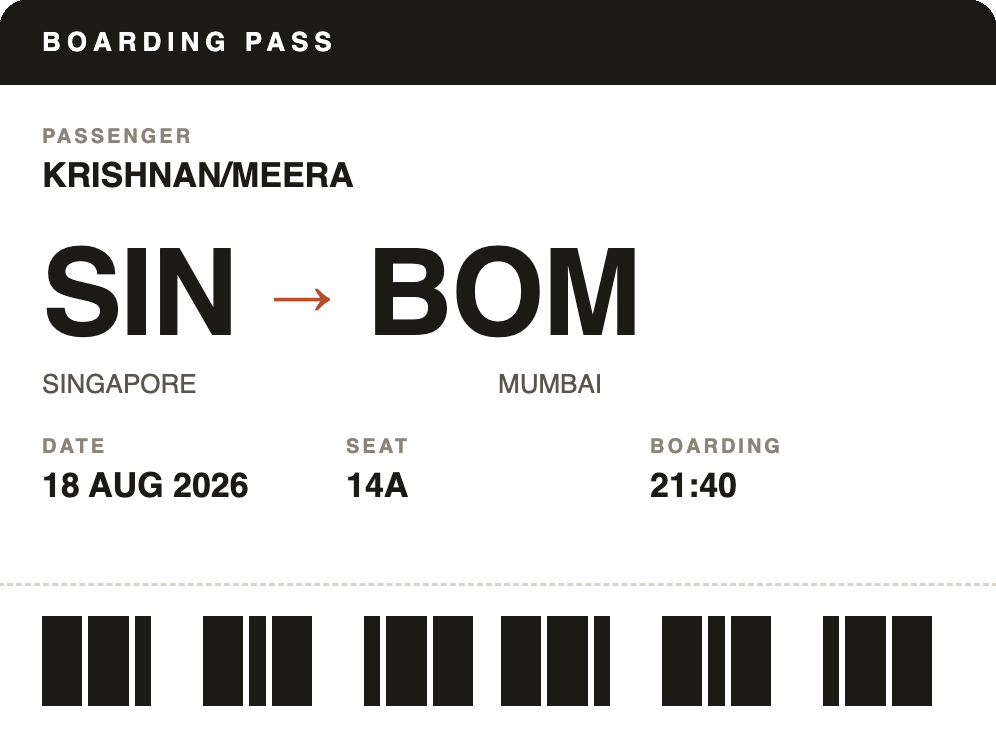
Days are counted from the dates you enter, arrival and departure days both included. The app keeps this count live from boarding passes, stamps and typed trips.
The tests, in plain words.
The 182-day test
In India for 182 days or more in the tax year (1 April to 31 March) and you are resident. This is the only test that depends on this year's days alone. Income-tax Act 2025 s.6, formerly 1961 Act s.6(1)(a).
The 60 + 365-day test
In India 60 days or more this tax year, and 365 days or more over the four preceding tax years, and you are resident. It does not apply to an Indian citizen leaving India for work abroad, or to a citizen or person of Indian origin who lives abroad and visits India; for them the 120-day test below applies instead. Formerly s.6(1)(c) and Explanation 1.
The 120 + 365-day test
For an Indian citizen or person of Indian origin who lives abroad and visits India, with income from Indian sources above ₹15 lakh: 120 days or more this tax year, and 365 days or more over the four preceding years, makes you resident but not ordinarily resident. Below ₹15 lakh, only the 182-day test applies to a visitor. Finance Act 2020; formerly Explanation 1(b) proviso.
Deemed residence
An Indian citizen with Indian income above ₹15 lakh who is not liable to tax in any other country by reason of domicile or residence is deemed resident, and treated as resident but not ordinarily resident. There are ways to avoid it or come out of it even when the conditions are met; speak to your tax adviser. Formerly s.6(1A).
RNOR: resident but not ordinarily resident
A resident who was non-resident in nine of the ten preceding years, or in India for 729 days or fewer over the seven preceding years, is RNOR and taxed mainly on Indian income. The 120-day and deemed-residence routes always give RNOR. Formerly s.6(6).
How a day is counted
Any part of a day in India counts as a day, so the day you arrive and the day you leave both count. The record is the passport stamps and boarding passes; a booking is not proof you travelled. Seafarers on eligible voyages leave those days out under Rule 126. Years before you start keeping a record are unknown, not zero, and a test that depends on them says so.
Rule set India, residential status v2026.2. Planning help, not tax or legal advice. The app shows how every figure was made, with the citation.
Keep the count live.
The app counts every stay from boarding passes, passport stamps and typed trips, on India's tax year, and warns you 60, 30 and 7 days before 182 or 120.